

Although the European Union promotes unity and open markets, business culture across Europe remains deeply diverse. Nowhere is this more visible than in the contrast between Eastern and Western Europe. These differences stem from history, politics, education, and societal values, influencing everything from how deals are negotiated to how teams are led. For international companies operating across the continent, understanding these cultural contrasts is critical to success.
The divide is not absolute; countries in Central Europe like Poland or the Czech Republic often blend aspects of both worlds, but the patterns are strong enough to affect daily business operations and relationships. This article highlights these contrasts to help you understand the European business culture more effectively.
Communication style: direct vs. indirect

In Western European countries like Germany, the Netherlands, and the UK, communication is often direct and explicit. People are encouraged to say exactly what they mean, even when delivering bad news. This low-context communication approach is viewed as efficient and respectful of everyone’s time, as it emphasizes clarity and straightforwardness, aiming to minimize misunderstandings.
By contrast, Eastern European business culture, especially in places like Poland, Romania, or Bulgaria, may lean toward a more indirect communication style. There’s often an emphasis on politeness, reading between the lines, and avoiding confrontation, reflecting a high-context communication style where non-verbal cues matter. This aligns well with a cultural preference for building relationships before diving into business matters
Misinterpreting this approach as indecision can lead to misunderstandings for Western professionals accustomed to quicker, more direct exchanges.
A manager from London might say, “This strategy doesn’t work,” while a manager from Kyiv might say, “Perhaps we should look at some other options,” implying the same message but in a softer form. Being aware of these nuances can prevent misinterpretation and promote smoother collaboration.
Understanding these differences requires adaptability. Western Europeans working in the East may need to invest time in relationship-building, while Eastern Europeans in the West should prepare for more candid discussions. Recognizing these nuances can prevent miscommunication and foster stronger partnerships.
Hierarchy and Decision-Making: flat vs. vertical structures
Western Europe, particularly in Scandinavia and the Netherlands, often embraces flatter organizational structures. Decision-making tends to be participatory, and junior employees are encouraged to voice their opinions. In Sweden, for example, group consensus is a major part of the decision-making process.
On the other hand, Eastern European businesses are traditionally more hierarchical. Managers are expected to lead decisively, and employees may hesitate to question authority or propose alternatives. This top-down approach can lead to slower decision-making processes but ensures clarity in roles and responsibilities. While this is slowly changing with globalization and younger leadership, the legacy of centralized governance still influences business behavior in countries like Serbia, Hungary, and Moldova.
The implication is clear: a Western executive expecting quick consensus in an Eastern setting may be surprised by deference to seniority and slower responses, while Eastern leaders working in flatter organizations may need to adjust to greater transparency and shared accountability.
Trust and relationship building
In Western Europe, particularly in Germany or the UK, trust in business is often built through contracts, credentials, and performance. Formal agreements matter more than informal conversations, and business relationships can start quickly, even between strangers, if the paperwork is in place.
In contrast, in many Eastern European countries, personal relationships still play a central role in building trust. Business can move more slowly in the early stages, as time is invested in getting to know the person behind the deal. A handshake may still hold symbolic value, but mutual acquaintances, hospitality, and face-to-face meetings are essential in forming lasting partnerships.
In practical terms, a Western investor may want to “get down to business,” while an Eastern counterpart prefers a long lunch and personal stories before moving forward. Understanding these expectations can avoid delays and build deeper cross-cultural rapport.
Risk-Taking and innovation attitudes
Innovation and risk-taking are generally encouraged in Western Europe, especially in tech-driven economies like those in Germany, Ireland, and the Nordics. Business culture promotes experimentation and accepts that failure is part of growth.
In Eastern Europe, caution may still outweigh boldness, shaped by decades of economic instability and cautious governance. Many entrepreneurs in the East are extremely creative and adaptive, but the broader business environment may still reward risk avoidance and thorough planning. Startups in regions like the Baltics are beginning to challenge this trend, but a more conservative mindset remains in many industries.
This difference means Western partners may expect faster pivots and changes, while Eastern partners may seek more time and detailed analysis before embracing a new direction.
A comparative overview
To sum up the key differences, the table below offers a comparative look at how Eastern and Western Europe approach common business themes:
|
Aspect |
Western Europe |
Eastern Europe |
|
Communication |
Direct and explicit |
Indirect and polite |
|
Decision-Making |
Participatory, flat hierarchy |
Hierarchical, top-down |
|
Trust Building |
Based on contracts and performance |
Based on relationships and personal rapport |
|
Risk Attitude |
Pro-innovation, accepts failure |
Risk-averse, prefers caution |
|
Speed of Relationship |
Fast-tracked through formal agreements |
Slower, relationship-driven |
|
Negotiation Style |
Focused on facts and outcomes |
Values trust, context, and history |
How does communication style affect collaboration in East versus West European companies?
Collaboration in Western European companies like those in Germany and France benefits from the direct communication style. Teams openly share ideas and concerns, which promotes transparency and quick problem-solving. The emphasis on clear roles and responsibilities, combined with a relatively flat organizational structure, encourages employees to contribute actively and engage in constructive debates. This environment supports innovation and efficiency, as misunderstandings are minimized and expectations are clear.
In Eastern European companies, such as those in Poland and the Czech Republic, collaboration is often influenced by hierarchical structures and indirect communication. Employees may hesitate to openly challenge ideas or management decisions, preferring to express concerns privately or through intermediaries. Building personal relationships and trust is crucial before effective collaboration can occur. This can slow down decision-making but strengthens team cohesion over time. Understanding these dynamics is vital for Western businesses working with Eastern partners to foster smoother cooperation.
How communication style influences negotiations in East vs. West Europe
Negotiations in Western Europe, exemplified by Germany and France, are typically straightforward and fact-based. German negotiators value preparation, punctuality, and clear terms. They expect open discussion and direct answers to questions, which helps to reach agreements efficiently. French negotiators also appreciate logical argumentation but may incorporate more formalities and diplomatic language, balancing directness with respect.
Conversely, negotiations in Eastern Europe, such as in Poland and the Czech Republic, tend to be more relationship-driven and indirect. Polish negotiators often prioritize building trust and may avoid outright refusals, instead using softer language to express disagreement. Czech negotiators similarly focus on long-term relationships and may use subtle cues to signal concerns. Patience and attentiveness to nonverbal communication are essential for success in these contexts. Western negotiators unfamiliar with this style may misinterpret indirectness as evasiveness, so cultural sensitivity is key.
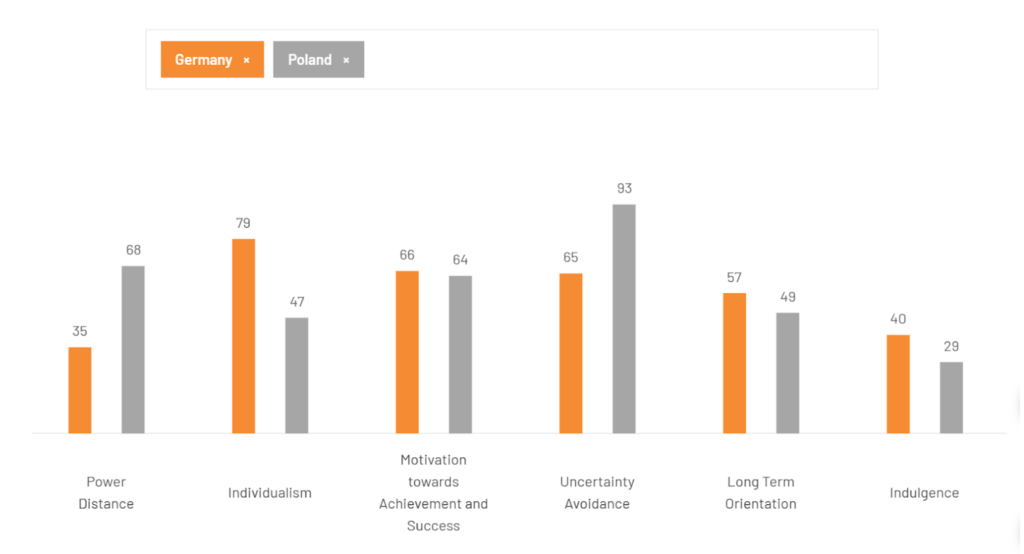
These cultural differences are clearly illustrated through the comparative scores on Hofstede’s six cultural dimensions between Germany and Poland, for example. By examining these scores, one can gain insight into the varying business practices and social norms across different European countries.
For a detailed comparison, refer to the Hofstede Insights Country Comparison Tool, which provides an interactive platform to explore these cultural dimensions.
Adapting your approach across the continent
Successfully exploring the business culture differences between East and West Europe requires cultural sensitivity, adaptability, and preparation. While it’s essential not to rely on stereotypes, understanding regional preferences helps avoid missteps and strengthens collaboration. For instance, Western firms entering Eastern markets should invest in personal trust-building and allow for more time in negotiations. Meanwhile, Eastern businesses expanding westward may benefit from embracing transparent communication and decentralized team input. Organizations that acknowledge and adapt to these cultural layers often find greater success in cross-border ventures, and build relationships that last beyond a single contract.
Contact us at Finevolution to discover which countries in Europe offer the best fit for your international expansion. Our team is ready to provide consultation on these issues. Our business hours: Monday to Friday, 9:00 AM — 7:00 PM. Contact us via WhatsApp, Telegram, or Viber, or submit an inquiry through our online form.


